
Franc Haverkort
In the first part of this two-part blog series we read how strategy changes from a static document to a rolling process. We also saw that leadership is about giving up frameworks and daring to let go. But how do you make employees actually take that space? And how do you make sure everyone comes out of their own silo and looks at the bigger picture?
When you as an organisation decide not to make strategy in the boardroom, but with each other, it requires different behavior. Other behavior of both leaders and employees. In the second part of this blog series we dives deeper into the dynamics of ownership with Franc Haverkort, partner at Groupmapping. If you like it, you should also get in and who participates, be prepared to look over his own fence.
If you like it, you should get in.
The sideline is the safest place in many organisations. It is the place of great non-committality where colleagues whisper to each other: "Well, what they have invented now ... If they ask me, I did it quite differently." But what happens if you take off that non-committality? The strategy process fundamentally different requires a new rule: if you like it, you have to get in.
Getting involved can be daunting
When inviting your colleagues to join us in thinking about the future and the strategy of the organisation, you take them out of the role of spectator. They can no longer sit back and review afterwards. You invite people to get in. That's exciting, because once people board you give them responsibility. Exciting for leaders, but also exciting for employees themselves. Instead of saying something from the sidelines, they have to show what they believe and build.
Equivalence, security and ownership
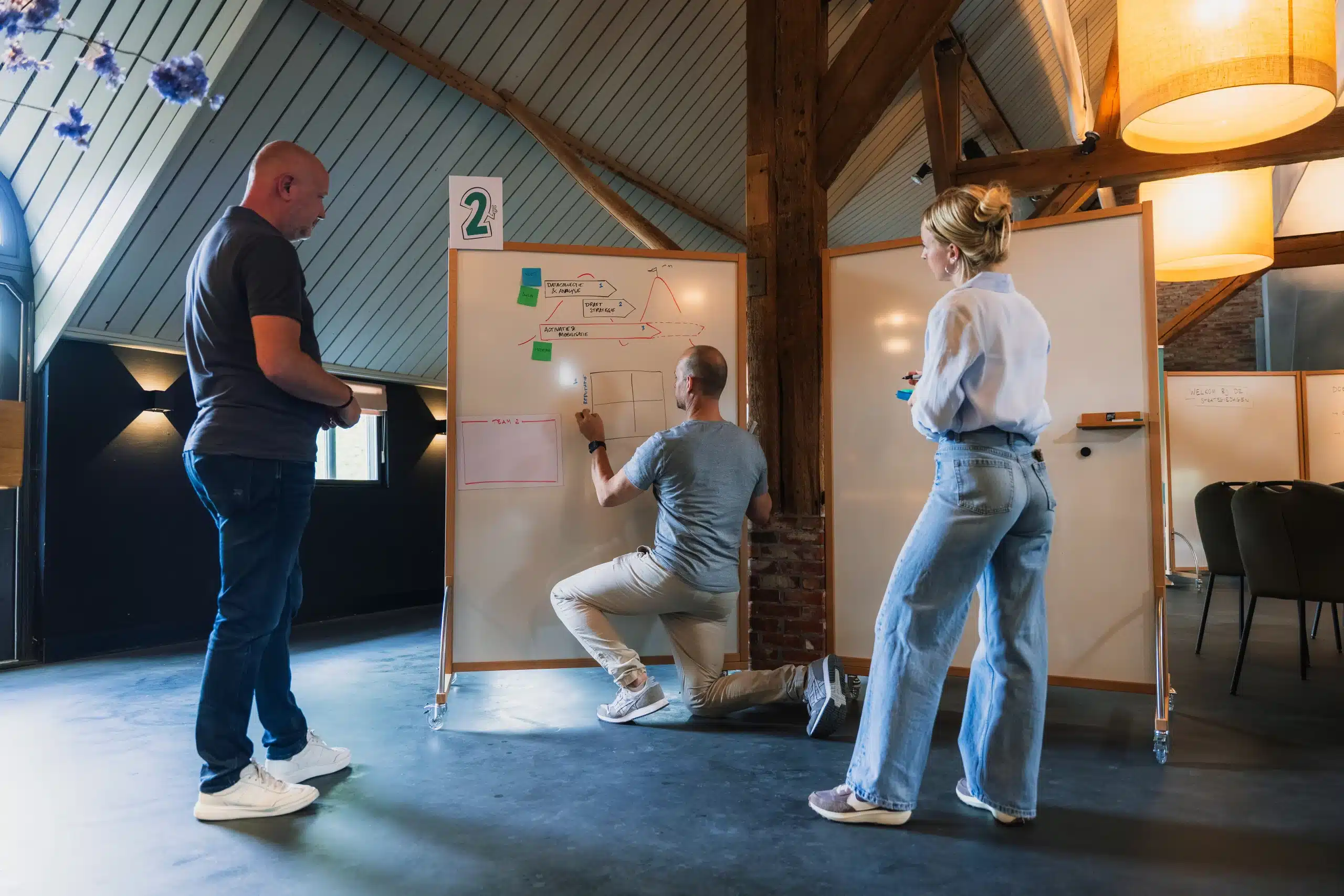
After directors have determined the frameworks and direction (see blog 1), making the strategy equivalence is an important condition in an inclusive process. Franc: "In practice, this means that in sessions and working groups organised by Groupmapping titles are left at the door. We prefer to see only first names on name badges, no grades, titles or functions. Whether you are director, manager or employee, everyone brings a perspective and everyone's perspective weighs equally heavily."
You can make sure that people really dare to get in and make an active contribution. Franc: "For example, by letting people work in small groups, you can make sure that everyone is present. Also, you can have participants in a work form write their opinions individually before they share them. This prevents the display of socially desirable behaviour or the re-enactment of the boss."
Dealing with 'cross-liggers' and informal leaders
The tendency is often to keep critics and troublemakers out of the door to keep the atmosphere right. Franc turns this around and encourages veterans who have already seen everything and the critical works council to invite them. If you ignore them, you organize your own resistance. In addition, critical sounds prevent groupthink and plan can be tested against the harsh reality. By involving them, the dynamics often change from 'we against them' to cooperation.
High motivation in government organisations
Finally, Franc notes that employees at government organisations often take the step easier to participate in than in many commercial companies. People working for government organisations often feel intrinsically connected to the organisation's social mission. As a leader, you should cherish this motivation by giving people the space to step in. This gives people the space to convert their intrinsic motivation into ownership.

Come out of your silo and see the bigger picture
When you choose an inclusive strategy and really engage the organisation, you quickly encounter the boundaries of departments. People are used to being driven by a specific task. It is a human tendency in organisations to define and protect the terrain, or the department, from disturbances from outside. It feels safe and clear in the silo (the policy tower). Targets are achieved, the budgets are monitored and every piece of "us" is done well. But without having noticed, the system is made available instead of the customer or the task.
The blind spot of the silo
This focus on its own square meter leads to enormous sub-optimisation. Franc sets out an appropriate example of an organisation in the public sector: "A process took 30 days to get a file through to the next department. It was already finished after a few days, but 30 days was the legal deadline that was before it. You saw this behavior coming back through the chain. The final result was that something that would only take two weeks, would take months in practice. A typical example of how one does it perfectly according to the rules in one's own silo, but lacks the sense of responsibility for the entire chain. The structure is leading and the intention gets out of sight."
The key is dialogue
Policy makers sometimes have to leave their silo to get their feet in the clay and implementers have to understand why policy exists. If you are a policymaker that fills the practice too much, you create a 'patat cutter': policymakers think up policies that apply to everyone. If they start thinking too specific and too practical, they will fill in the practice for everyone. It is much more logical to write framework and policymakers that can be further developed by the practice. The 'practice' is in many different forms and sizes. It requires leadership that dares to say that the basic idea is good, but needs to be kept in mind for reality and practice.
Silo's aren't broken down by ordering otherwise
When silos hinder the process, the tendency to break them down often arises by changing the structure of the organisation. The tragedy is that a new order often creates new silos. People will always look for an answer to the question: where are we from? When they get into a new structure they will automatically demarcate their own piece.
Silothinking not only solves the problem by adjusting an organogram, but by asking: why do we do this? So the solution is not always in reorganising, but in connecting. Stop thinking for each other and talk to each other. Get out of that comfortable silo. If you understand why your piece fits into the larger picture, you will have real connection.
The most important lesson: full dedication
Franc: "The main point of learning in applying inclusive strategy is to stand by it and to continue it as soon as you make that decision. This way of working does not necessarily make the process easier, but better. And is therefore absolutely worthwhile."
Ready to turn strategy into a joint process?
Contact us and find out how to use the thinking power of your entire organisation.
Sharper, faster, smarter: I want that too!
We'd love to hear that.