Tommes Snels:
For over 20 years, I have been working with organisations on change. Not by making even better plans, but by bridging the gap between strategy and execution. Driven by a people-centred philosophy, we at GroupMapping help make strategies really roll. Wondering how? Read on or get in touch.
For those who may not feel like digging through my LinkedIn profile: Tommes is my first name, Snels is my last name and I have been allowed to deal with all kinds of large and smaller changes in organisations for about 20 years. In Europe and even Australia. I (we, at GroupMapping) never do that alone and always from a very rich philosophy and methodology, focused on people and collaboration (very flatly put). Of which Matt and Gail Taylor are the founding fathers and in which very, very different methods and approaches come together.
We flew out of 2025 at GroupMapping and into 2026 ‘full throttle’, which made me wonder at the end of the first few weeks where this huge bucket of energy I feel comes from.
The first weeks of this year were characterised by many incredibly interesting conversations, within our ongoing projects but also with new faces for us. From different organisations facing challenges. And whether it was about “upcoming strategy recalibration”, “bringing strategy into operation”, “shaping a fundamental transformation” or “accelerating the project”, each time a number of issues came up: agility, resilience, decision power and humanity and “what should we do with AI?”.
Not surprising when you consider that organisations are the construct within which people work together ...
It may be pretty chewed out by now, but it is no less true for that: the world we live in is more fragile, uncertain, non-linear and incomprehensible than ever. And this directly affects people. In private life and, of course, in work. Trust, energy, perception and (personal) leadership are, in my opinion, of great importance to cope with this demanding world.
During my out-of-the-window reflection, I thought of delving into our projects of the past ten years, looking for patterns and common threads. I didn't do that on my own, but our friend Gemini gave me a hand (with an average of 70 projects a year, that was just a bit too much for my limited processing capacity). And some pretty interesting insights came out of that. Insights that I then also started testing in the worldwide web world and once again I was happy with our friend (NB: we work with a heavily secured version).
Among other things, it came out with this:
“The gap between strategy and execution is one of the most researched but least solved problems in management science. From an in-depth analysis of the top 10 global studies and frameworks, a clear, overarching conclusion emerges: the execution gap is not a primarily technical, process or intellectual problem. It is a fundamentally human, cultural and leadership problem. The most brilliant plans, the most sophisticated models and the most detailed project plans fail if they ignore the complex realities of organisational dynamics, human behaviour and the need for adaptive leadership.”
As a result, I had to go back to my (somewhat elaborate) prompt, just to make sure I hadn't written it in such a way that I would end up in the ‘confirmation bias’ tunnel (“See? I thought so!”). The prompt was generic enough, thankfully
Another conclusion did even more to me:
“We face the paradox of knowledge: we know more than ever about why strategies fail, and yet they continue to fail on a large scale. Failure rates from 70% to 88% have been shockingly stable for decades. This suggests that the challenge lies not in accumulating even more knowledge, but in having the courage, discipline and humility to apply the known principles consistently. Success requires a holistic approach that combines radical focus, nimble execution, people-centred implementation and disciplined leadership.”
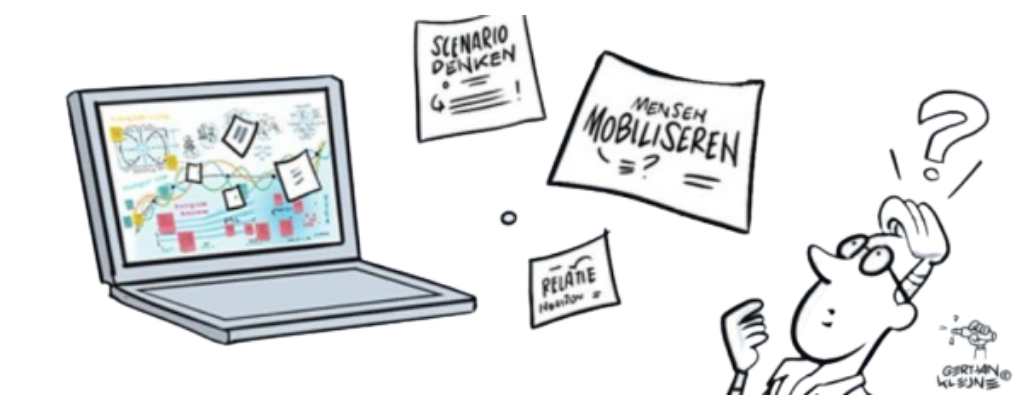
Courage, discipline, humility. Typical human qualities. In addition, radical focus and ruthless prioritisation (theme 1) also emerged from all surveys. Not wanting everything, daring to say no, focus and leadership are essential in this.
Nimbleness and iterative learning (agile, so to speak, theme 2), in short cycles, aimed at adapting on the basis of new insights, also appear to be very important. Again, typically one of those sets of things that are part of our nature as humans, but have been unlearned to us, from an early age.
A third theme that emerges from all the studies is people-orientation and ownership. People-centredness in the development and execution of a strategy, ownership of the choices (to be) made and their meaning (the why) appear to be able to lead to success. These three themes are about people, knowledge, skills, insight and especially cooperation.
The fourth theme was also no surprise: disciplined governance and visible measurement of success. A theme that ideally provides room for all kinds of frameworks, methods and approaches. Which, of course, can also be useful in the other three themes. Shared insight, understanding and language are crucial within all four themes.
In one of those incredibly interesting conversations, I was talking to my interlocutor about what it then takes, for example, to bring a strategy to life at high speed.
We have been preaching for years that a strategy should roll, that you should not keep trying to ‘create a new strategy’. And in that rolling, let all your people play a role. You build the bridge between strategy and results together, in which courageous leadership dares to make difficult choices. In which you involve all your people and dare to give your very best talent a leading role. In which you realise that your organisation not only has to perform, but above all has to be able to adapt and change when the context demands it.
And even then, it is simply about people and how you help and support them in this. And that is exactly what we like to help with.
Curious about even more insights, from us and/or with the help of our friend Gemini? Above all, play around with building a good prompt yourself, but also don't hesitate to give us a call.